
Student visa interview preparation on Android works because the phone in your pocket is the device you will actually rehearse on. The apps below run on it, but the preparation itself starts earlier than most students think: officers open with your study plan and move quickly to your money. If you cannot state your destination's financial proof figure and where it comes from, polish on the later answers will not save you.
The money question comes first: what each destination asks you to prove
Our student visa database records the minimum financial proof for 100 of its 102 destinations, and the spread is wide. The median destination asks for $4,450. The ten destinations most students actually apply to sit far above that median, which is why the money question carries so much weight in the room.
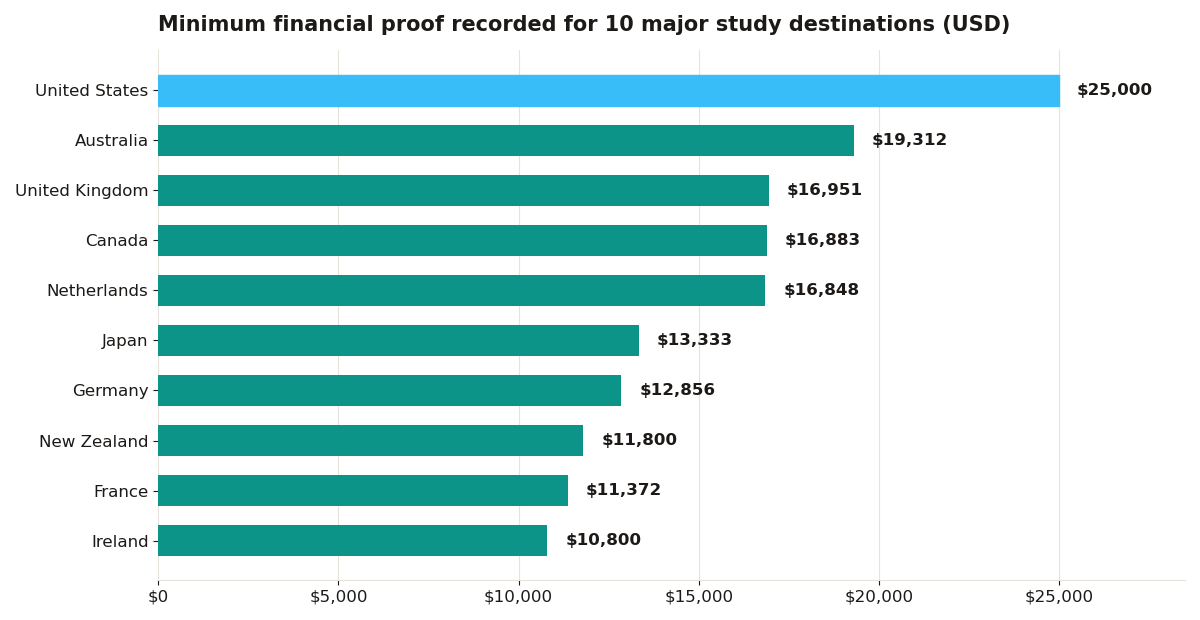
Source: GlobalStudyConsulting student visa database, 102 destination records, Oct 2026 snapshot; minimum financial proof in USD as recorded per destination (100 of 102 records state a figure).
The United States tops the chart at $25,000, and the F-1 record in our database lists eight required documents, including the Form I-20, the DS-160 confirmation page, the SEVIS fee receipt, proof of financial support, and proof of ties to your home country. An officer asking "who is sponsoring you, and what do they earn?" is checking your answer against exactly that paperwork. Australia follows at $19,312, then the United Kingdom at $16,951 and Canada at $16,883. Germany asks for $12,856, the figure behind its blocked account. Know your destination's number, know which account holds it, and know whose name is on the account. That is the first fifteen seconds of the interview, rehearsed.
The Android apps worth your practice time
- VisaMock (Android): $9.99 per mock session. Records your answers, scores content and delivery.
- Yocket (Android): free question banks and debriefs from past applicants.
- F-1 Visa Interview Q&A apps (Play Store): flashcard-style questions, free, no scoring.
- LeapScholar (Android): mock interviews with counsellors, free for their users.
Use the flashcard apps for recall and the scored apps for delivery. F1 visa interview tips are everywhere; timed answers under pressure are not. Do three full mocks before the real one, out loud, with a timer running, and record at least one of them so you can hear where you rush.

The eight documents behind the F-1 money answer
The F-1 record in our database lists eight required documents, and most interview questions trace back to one of them. The Form I-20 from your SEVP-certified school sets the cost figure your sponsor has to cover. The DS-160 confirmation page and the SEVIS I-901 fee receipt prove the application itself is real and paid for. The passport-style photo and valid passport are the basics. The three that decide interviews are the proof of financial support, the visa application fee receipt that shows the file is complete, and the proof of ties to your home country, the evidence that you intend to depart when the program ends.
Preparation means being able to talk about each one without hesitating. Who issued the I-20, and what is the total cost printed on it? Which bank holds the sponsor's funds, and how long have they been there? What does your sponsor do for a living, in one sentence? What exactly are your ties at home: family, property, a job offer, a business? Officers ask these in plain language and listen for answers that match the documents. If your spoken number and your I-20 number differ, everything after that gets harder.
A two-week preparation rhythm that works
Spread the work instead of cramming it. In the first week, run one untimed pass a day through the question set and fix the content: the study plan, the university choice, the sponsor story, the ties. In the second week, switch to timed runs, two minutes per answer at most, because real F-1 interviews are short and an answer that rambles reads as rehearsed in the wrong way. Finish with two full mocks on the device you will carry on the day, standing up, out loud. The apps above handle the question banks; the rhythm is what turns a bank into readiness.
Rehearse the real format before it counts
The Visa Interview Simulator runs the full interview format on the web, no install needed: pick the United States F-1 track, answer the questions in order, and get a scored verdict on your study plan, your funds answers, and your ties to home. It is the closest rehearsal for the money questions in the chart above, because it asks them the way an officer does, early and without warning.
Pair it with the format guides on this site: the top 5 student visa interview practice apps compared and the checks to run before you download an interview questions app. Then read the F-1 processing time and fees guide so the timeline answers are as ready as the money answers. Figures change, so confirm your destination's current requirement on the official source before you apply.
Sources: U.S. State Department